Scanlan: Karlsson the catalyst for improved Senators’ defence
OTTAWA — Last spring, the Ottawa Senators’ defensive corps was bruised and beaten, in rough shape — and that was just from abuse hurled at them by media and fans.
There was basis for the criticism. From the moment Filip Kuba broke his leg in training camp, Ottawa’s defence seemed to be in distress. Sergei Gonchar needed a period of adjustment after coming over from Pittsburgh. Chris Phillips missed his stalwart partner, Anton Volchenkov. Erik Karlsson was still in the early stages of becoming Erik Karlsson.
Toss in Daniel Alfredsson’s bad back, some lacklustre forward play, plus the indifferent goaltending provided by Brian Elliott and the perma-injured Pascal Leclaire, and it’s no wonder the Senators had the fourth-worst goals-against average in the Eastern Conference, yielding 3.04 goals per game. Their 250 goals allowed was the most by a Senators team since the bad old days of 1995-96, when they gave up 291.
Perhaps worse, Ottawa’s goal differential, minus-58, was dead last in the East.
And this season? While the improvements appear modest — a jump to sixth-worst in goals against with a 2.93 average per game, gone are those ugly minus stats, replaced by shiny plus figures, partly because the Senators have already scored more goals, 199, than they did all last season (192).
In 2010-11, Phillips was minus-35, Karlsson minus-30, Kuba minus-26 and Gonchar minus-15.
This season, Kuba is plus-20, Karlsson plus-15, Phillips plus-2, Gonchar minus-1.
Overall, the team is a plus-7, having crawled out from negative territory in the second half of the season.
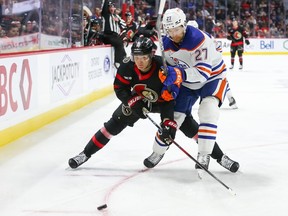
It hasn’t hurt the cause that one among them, Karlsson, has blossomed into one of the top defencemen in the NHL, and far and away the most prolific blue-line producer with 66 points in 64 games.
When I asked Phillips, the longest-serving Senators defenceman, about the defensive improvements over last season, he quickly turned and pointed to the stall close by. The dressing stall, of course, of No. 65, the 21-year-old Swede who has exploded with 18 points in an ongoing eight-game points streak.
With 17 games remaining, Karlsson has already passed Norm Maciver’s franchise record for points by a defenceman (63).
“Karlsson playing the way he has is maybe the biggest difference,” Phillips said, comparing this season to last. “He has made all of us look better, just because he’s on the ice, playing the minutes, he’s making the difference.”
Where there might be trouble, Karlsson skates the puck to safety — and just as quickly into a scoring opportunity.
While no one else on the team can play like Karlsson, the group is doing a better job of joining the rush in general. There exists a synthesis between defence and forwards that last year’s team could only dream about.
“I think having D-men jump up in the play and getting involved is something that helps the forwards,” Phillips says. “Being involved, being an option (for a pass), forces the other team to back off, not play them as hard, be aware of guys jumping up. That gives forwards more time with the puck and time to make plays.”
Karlsson’s emergence as an elite defenceman aside, there have been other defensive improvements in a rebuilding season:
• Personnel — Was it really only last season that Ottawa’s defence was counting on the likes of David Hale and Chris Campoli, even Derek Smith? This season, the blue-line is championed by: A revitalized Phillips; Kuba and Gonchar having rebound years; and now some added mobility with Matt Gilroy in place of Brian Lee. Rookie Jared Cowen has had his growing pains, but has had a strong first season overall. A sign of Ottawa’s depth on the blue-line: Matt Carkner is often a healthy scratch this season and when he is used, he plays 12 minutes or so per game. Last season, he averaged nearly 15 minutes per game on a thinner blue-line.
• Goaltending — If a goalie is a team’s “best penalty killer,” as the cliche goes, he is also the defenceman’s best friend. Until he sliced his finger, Craig Anderson was the support beam of the House of Senators, the last line of defence, providing stability the Senators did not have least season . . . until they traded for Anderson, sending Elliott to Colorado, prior to the trade deadline. With Anderson now sidelined temporarily, Robin Lehner has delivered two strong games and will be in again versus the Chicago Blackhawks Friday, an intriguing matchup of combative types, with ex-Senators stopper Ray Emery starting for the Blackhawks.
• All hands on deck — A rising tide lifts all boats. Every aspect of the Senators’ game has improved this season, making Ottawa’s blue-line one of the beneficiaries.
As Phillips put it, “The team is just playing better. Forwards are coming back and being available, we’re breaking out as five-guy units. It makes us look better, makes our job easier, we’re not playing in our own zone as much.”
Phillips doesn’t believe the system has changed dramatically under new head coach Paul MacLean. As he says, the expectation is always there for forwards to help out in the defensive zone, and for defencemen to move the puck.
“For whatever reason,” Phillips says, “that seems to be happening more easily than in the past couple of years.”
wscanlan@ottawacitizen.com
Twitter.com/HockeyScanner
I wonder if all of this is for nothing… Seeing as how Ottawa is not a big enough market to keep 1 pro sports team… How sad!
I think the revitalization, and Karlsson’s emergence, is mainly down to Kuba being healthy. Two years ago, before the broken leg, when he came back in mid-season from an injury, he transformed the Senators’ play then too. Gonchar and Phillips were far better than the boo-birds allowed last season, and are playing to their ability under MacLean’s new régime.